
Kinds of Tomato Fertilizer
Since 2010, Tomato Dirt has garnered 4.6+ million views, making it the web’s leading online source for growing tomatoes in the home garden. Award-winning writer and Tomato Dirt owner Kathy Widenhouse has helped thousands of home gardeners grow healthier tomatoes. Be one of them when you get Tomato Dirt’s Growing Guide here.
Effective tomato fertilizer, whether organic or not, provides nutrients tomatoes need at different stages of growth.
Before you leave ...
Get your free copy of "10 Must-Know Tomato Growing Tips." This 20-page guide is filled with tips you need to know to have a successful tomato crop, whether you’re a beginning or experienced gardener.
What nutrients tomatoes need
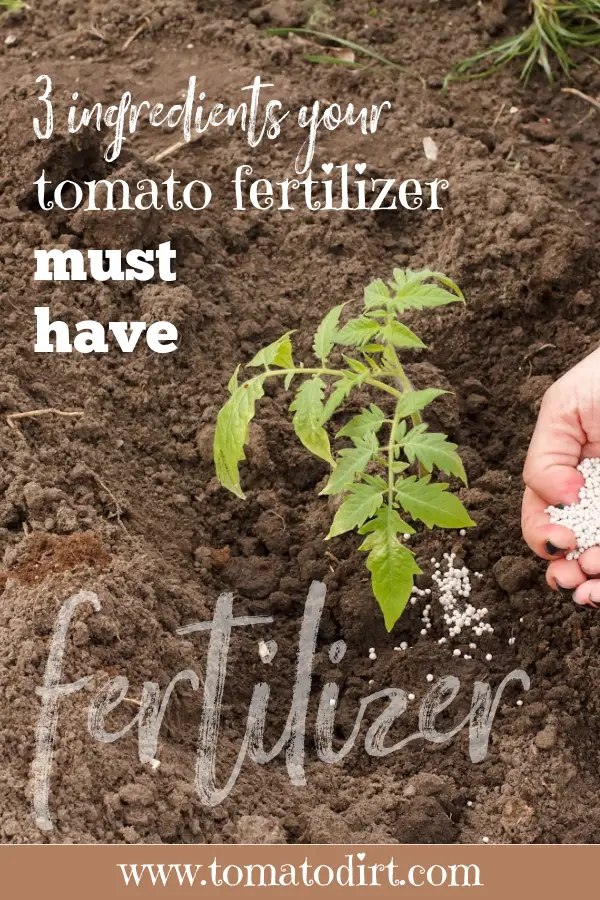
To grow successfully, tomatoes need nitrogen, phosphorus, potassium, potash, calcium, and magnesium, along with other trace minerals.
It’s always best to have your soil tested to check for nutrient levels and pH. You can test your soil yourself, both its nutrient levels and its pH, in a simple, inexpensive soil test kit. Or contact your local extension office and ask about local soil testing services. Tou can also find simple (but accurate) pH test kits online.
Test results may show a particular nutrient deficiency. Then you can amend your soil appropriately. Soil nitrogen content should be higher than phosphorus content.
The next step is to select a tomato fertilizer.
How to read a fertilizer package
Most fertilizers are a combination of the three nutrients commonly fed to plants: nitrogen, phosphorus, and potassium (referred to as the “N-P-K ratio”).
A commercial fertilizer’s analysis is listed on the label in a three-number series, such as 15-10-5. The three numbers represent those three nutrients. A 15-10-5 fertilizer contains 15% nitrogen, 10% phosphorus, and 5% potassium. The remainder of the fertilizer is filler material.
What fertilizer nutrient balance to choose for tomatoes
Nitrogen. Nitrogen encourages leaf growth, which is why fertilizers with higher ratio of nitrogen (the first of the three numbers) are an optimum choice for lawns and grasses. But in tomatoes, excess leaf growth discourages blossoms and fruit.
A complete fertilizer with a balanced supply of the three major nutrients, such as 10-10-10 or 5-10-10, is a better choice for tomato plants at initial planting time. Stay away from high-nitrogen fertilizers such as urea, ammonium sulfate or fresh manure, which will help produce dark green, tall tomato plants but fewer tomatoes.
Phosphorus. Phosphorus (the second number in the N-P-K ratio) encourages flowering, and therefore fruiting.
Potassium. Once a tomato plant starts flowering, it needs a higher ratio of potassium (the third number in the N-P-K ratio). Good organic sources of potassium are granite dust and wood ash.
Specialized tomato fertilizer
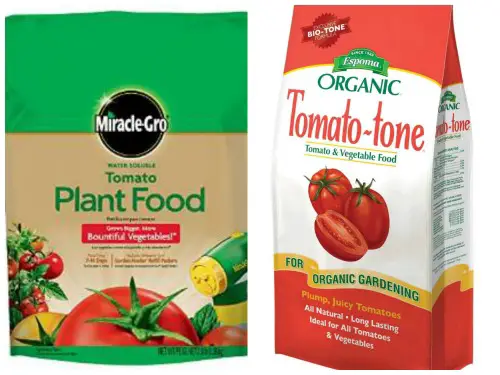
Two fertilizers specially formulated for tomatoes are :
Miracle-Gro Tomatoes (18-18-21), a crystal formula that is mixed with water and applied through a hose, sprayer, or sprinkler
Tomato Tone: (4-7-10 or 3-4-6): a granular fertilizer that is worked into the soil. Tomato Tone is organic and contains calcium, magnesium, sulfur and trace nutrients.
When to add nutrients during the tomato season
Once a plant is established in the garden, a phosphate-concentrated application (such as 0-46-0 commercial fertilizer) every 6-8 weeks increases tomato production. Bone meal, with an analysis of 4-12-0, is a good organic source of phosphorus. When a tomato plant sets fruit, start a systematic fertilization program and feed every three weeks until frost.
More on fertilizing tomatoes
Fertilizing Tomatoes: Frequently Asked Questions ...
How to use tomato fertilizer to get the best tomato production
Organic tomato fertilizer: advantages and disadvantages...
Epsom salts: a natural tomato fertilizer ...
Does tomato fertilizer potency stay strong over time?
Tomato fertilizer question: will this fertilizer work for tomatoes?
More on growing tomatoes
Staking tomatoes produces a bigger, healthier harvest ...
Watering tomatoes when planting and just afterwards ...
Watering tomato plants: the basics ...
Watering tomatoes: FAQs (Frequently Asked Questions) ...
Techniques for watering tomato plants ...
How and when to mulch tomatoes ...
What's the best mulch for growing tomatoes?
How to control weeds in the tomato garden ...
Pruning tomato plants: how and when to do it ...
Growing tomatoes: top 4 areas of tomato care ...
See more on our Fertilizing Tomatoes Pinterest board...
Return from Kinds of Tomato Fertilizer to Tomato Dirt home
As an Amazon Associate and Rakuten Advertising affiliate I earn from qualifying purchases.
SHARE THIS PAGE:
FREE! 10 Must-Know Tomato Growing Tips: 20-page guide
Get yours here:


New! Comments
Have your say about what you just read! Leave a comment in the box below.