
FREE: 10 Must-Know Tomato Growing Tips Get The Guide
Read our affiliate disclosure here.
Compost Ingredients: What to Put
in Your Compost Pile (and What to Leave Out)
Since 2010, Tomato Dirt has garnered 4.8+ million views, making it the web’s leading online source for growing tomatoes in the home garden. Award-winning writer and Tomato Dirt owner Kathy Widenhouse has helped thousands of home gardeners grow healthier tomatoes. Be one of them when you get Tomato Dirt’s Growing Guide here.
Posted 9.18.26
Compost has a reputation for being complicated.
Carbon-to-nitrogen ratios. Browns and greens. Moisture. Aeration. Temperature.
Suddenly, tossing a banana peel into a pile of leaves sounds like advanced chemistry.
Fortunately, compost ingredients are much simpler than they sound. At its heart, a compost pile needs four things: carbon-rich materials, nitrogen-rich materials, water, and air. Give the microorganisms in your pile a reasonably balanced diet, enough moisture, and enough oxygen, and they'll do the hard work for you.
The result? Dark, crumbly, earthy-smelling compost that can improve soil structure, help soil retain moisture, and return organic matter and nutrients to your garden.
Here’s the dirt on those amazing compost ingredients that can help create black gold for your tomato garden.
Before you leave ...
Get your free copy of "10 Must-Know Tomato Growing Tips." This 20-page guide is filled with tips you need to know to have a successful tomato crop, whether you’re a beginning or experienced gardener.
What are the ingredients of
compost?
The basic ingredients of a successful compost pile are:
- Brown materials: carbon-rich ingredients
- Green materials: nitrogen-rich ingredients
- Water: enough moisture to keep microorganisms active
- Air: oxygen to support aerobic decomposition
Think of your compost pile as a tiny ecosystem. The microorganisms that break down the raw materials need carbon for energy and nitrogen for growth. They also need water and oxygen. When those ingredients are reasonably balanced, decomposition gets underway.
Compost ingredients your pile needs
1. Brown compost ingredients:
Carbon
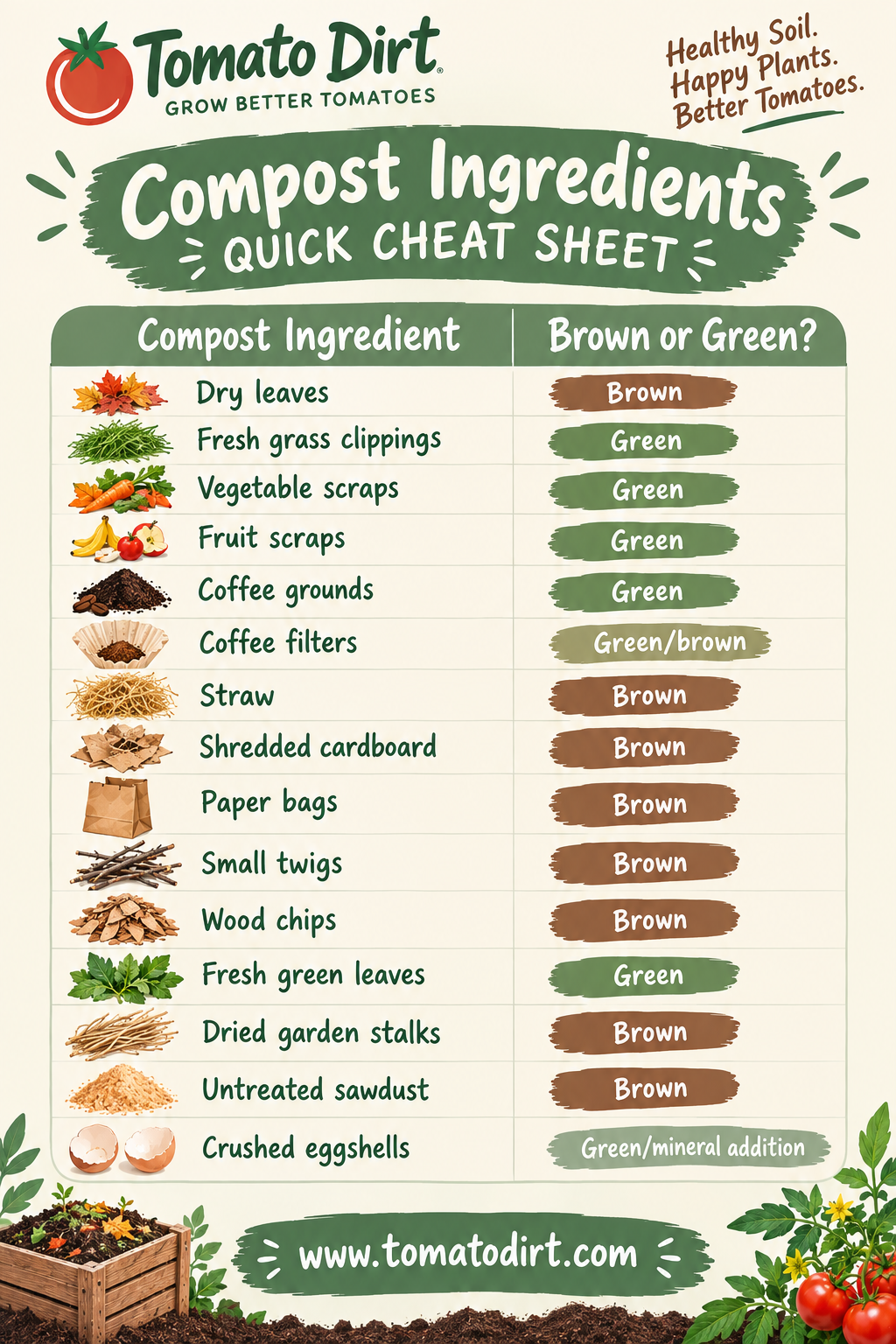
Brown materials are your compost pile's carbon supply. They provide energy that microbes need for the hard work of decomposition. Common brown compost ingredients include:
- Dry leaves
- Straw
- Small twigs
- Wood chips
- Untreated sawdust
- Shredded cardboard
- Shredded brown paper bags
- Plain, non-glossy paper
- Paper coffee filters
- Dried plant stalks
- Corn stalks
- Pine needles
Dry leaves are particularly useful in your compost pile because they're easy to collect, store, and add throughout the year. EPA specifically recommends dry leaves, plant stalks, twigs, shredded paper, cardboard without wax or tape, and untreated wood chips as carbon-rich materials for backyard composting.
Garden tip: Don't bag up every autumn leaf and send it away. Your future compost pile may be very interested in them. A simple leaf pile is one of your most valuable compost resources.
2. Green compost ingredients:
Nitrogen
Green materials supply nitrogen – an element that’s got a reputation for helping living organisms to grow. In this case, nitrogen will work its multiplying magic on the microorganisms in your compost pile. Common green compost ingredients include:
- Fruit scraps
- Vegetable scraps
- Fresh grass clippings
- Fresh green leaves
- Soft green garden trimmings
- Coffee grounds
- Plain paper coffee filters
- Tea leaves and tea bags
- Crushed eggshells
- Fresh weeds without mature seeds
- Plant-based kitchen scraps
Despite the name, "green" doesn't literally mean green. A banana peel is a green compost ingredient even though it's yellow. Coffee grounds are considered a green material even though they're brown.
The secret:
Don't obsess over individual compost ingredients
In compost language, green means nitrogen-rich, not necessarily green-colored. Likewise, brown means carbon-rich, not necessarily brown-colored.
Here's where beginning composters sometimes get stuck.
- "Is a banana peel a green?"
- "Are pine needles a brown?"
- "Where do coffee grounds go?"
- "How many eggshells can I add?"
Those are useful questions, but you don't need to create a laboratory-perfect pile.
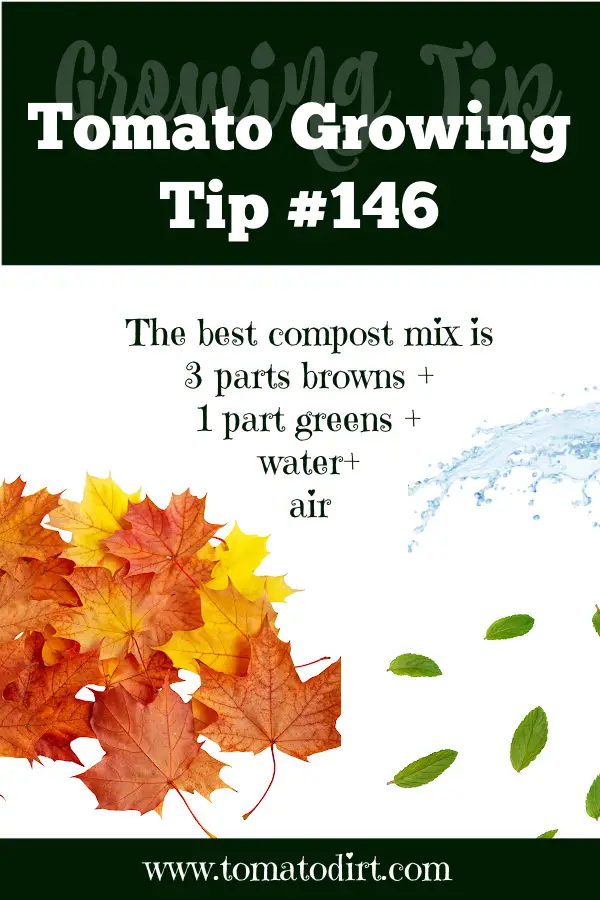
The goal is to create a balanced mixture of different organic materials. The EPA recommends roughly two to three parts brown materials to one part green materials by volume for backyard composting. In other words, keep plenty of browns on hand, and mix them generously with your greens.
That's much easier than carrying a calculator out to the compost bin.
What is the best compost mix?
For a backyard compost pile, a good starting point is approximately:
2–3 parts browns + 1 part greens + water + air
By "parts," you can use whatever measuring system is convenient, such as …
- 3 buckets of dry leaves
- 1 bucket of vegetable and fruit scraps
- A little water if the pile is dry
- Regular turning or mixing to introduce air
You don't have to measure every bucket precisely. In fact, variety may be more useful than precision. A pile containing leaves, grass, vegetable scraps, coffee grounds, shredded cardboard, and small pieces of yard waste gives decomposers a diverse menu.
Troubleshooting what compost
ingredients to add to your compost pile
The important thing is to watch what your pile is telling you.
If your compost smells bad...
A strong rotten or unpleasant
odor can indicate too much moisture, insufficient oxygen, or an imbalance in
the materials. Try adding more dry brown material and turning the pile to
introduce air.
If your compost is wet and
slimy...
Add dry browns such as dry
leaves, shredded cardboard, straw, or dry plant material. Then mix the pile.
If your compost is dry and
nothing seems to be happening...
Add water. Your compost should be
moist but not soggy—roughly the consistency of a wrung-out sponge.
If your compost isn't heating
up...
You may need more nitrogen-rich
green material, more moisture, or a larger volume of organic material. Turning
the pile can also improve oxygen flow. Don't panic, though. A cool
compost pile isn't necessarily a failed compost pile. It simply may be
decomposing more slowly.
Compost ingredients FAQs
Q. What are 5 items that should
not be composted?
For a typical backyard compost pile, five categories to leave out are:
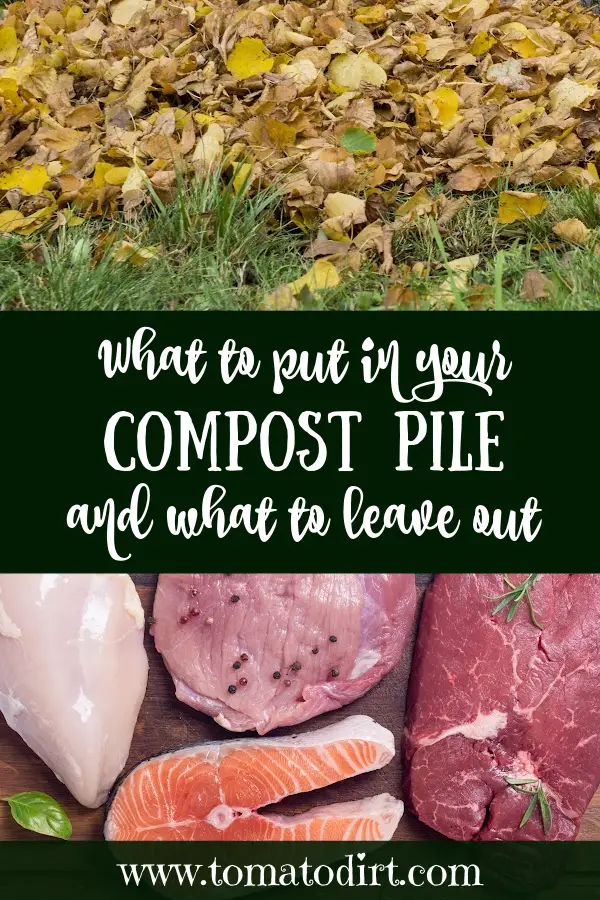
- Meat, fish, and bones
- Dairy products such as cheese
- Fats, oils, and grease
- Pet waste and cat litter
- Herbicide-treated plants or grass
EPA also recommends keeping treated or painted wood, diseased or pest-infested plants, glossy paper, produce stickers, and aggressive weeds or weeds with seeds out of a backyard compost pile.
Why? Foods listed above can attract rodents and other unwanted visitors. Fats, grease, pet waste, and seeds may not break down safely or completely in a typical backyard pile. Painted wood and herbicide-treated plant material is particularly important to avoid because you don't want chemicals or persistent herbicides ending up in the compost you eventually add to your garden.
Q. What about cooked food?
This one is a little more complicated. Some composting systems accept cooked food, meat, dairy, and other materials that aren't recommended for ordinary backyard piles. Commercial composting facilities can use different processes and reach temperatures that backyard piles may not consistently achieve.
So don't automatically assume that "compostable" means "put it in my backyard pile." Check the rules for your particular composting system.
Q. Can I compost grass clippings?
Yes. Fresh grass clippings are a nitrogen-rich green compost ingredient and can be useful in a compost pile.
But there's a catch. A giant pile of fresh grass clippings can become compacted and wet, reducing airflow. Instead of dumping a mountain of grass into your compost bin all at once, mix grass clippings with plenty of dry leaves, shredded cardboard, or other brown material.
And if you've treated your lawn with herbicides, check the product label and follow its restrictions before adding those clippings to compost.
Q. Can I compost leaves?
Absolutely. In fact, leaves are some of the best compost ingredients for a home gardener. They're abundant, inexpensive, and carbon-rich. Dry leaves can also help solve one of the most common composting problems: too many wet, nitrogen-rich kitchen scraps.
- Keep a stash of dry leaves near your compost pile. When you add a bucket of food scraps, add a few handfuls—or more—of dry leaves along with them. Dry leaves or other brown material also help discourage pests.
- Shred leaves, if possible. Smaller pieces of organic material provide more surface area for microorganisms and can break down faster. You don't need to chop every leaf with garden scissors, though. Simply run over them with the lawn mower before collecting them and adding them to your compost pile.
Q. Can I compost coffee grounds?
Yes. Coffee grounds are a popular nitrogen-rich compost ingredient. Add them along with other greens, but don't build your entire compost pile around coffee grounds. Mix them with plenty of carbon-rich material like dry leaves, shredded cardboard or paper, straw, and dried plant material.
Q. Can I compost eggshells?
Yes, although eggshells behave a little differently from vegetable scraps.They don't break down as quickly as many soft organic materials. Crushing them into small pieces helps.
Think of eggshells as a useful addition rather than a major ingredient in your compost recipe. If you find bits of eggshell still hanging around when you screen your finished compost, simply return them to the active pile.
Q. Can I compost weeds?
Sometimes. Young, ordinary weeds without mature seeds can be composted in a properly managed pile.
But be cautious with weeds carrying mature seeds, aggressive spreading weeds, plants that reproduce from rhizomes, or weeds treated with herbicides. Your backyard compost pile may not consistently reach the temperatures necessary to kill every weed seed or plant pathogen.
If you're not sure, leave the questionable weed out. It's much easier to throw one weed in the trash than to spend three years pulling its offspring out of your tomato bed.
Q. What about adding diseased and
pest-infested plants to my compost pile?
This is another "better safe than sorry" situation. Leave them out. The reason is simple: you don't want to create a cozy little recycling program for plant pathogens or pests and then spread the resulting compost around next year's garden.
- Healthy spent plants can be excellent compost ingredients.
- Compromised plants? Give them a different destination.
Q. Do compost ingredients need to
be layered?
Not necessarily. You may see composting instructions that tell you to build alternating layers of brown and green materials, almost like making a lasagna. That's one way to do it.
But you can also mix materials as you add them.
The bigger goal is to combine carbon-rich and nitrogen-rich materials throughout the pile, rather than creating a thick layer of one material and leaving it that way.
Don’t worry if your compost pile isn't Pinterest-perfect. The microbes don't care.
Q. What is the best homemade
compost?
The best homemade compost is finished, dark, loose, crumbly earthy-smelling, and largely free of scraps and plant materials.
You don't need exotic ingredients … expensive compost starters … a secret recipe handed down by a master gardener.
A well-maintained backyard pile can produce finished compost in roughly three to five months, although conditions and management make a big difference. An untended pile can take much longer.
Here’s the key distinction: Finished compost is not the same thing as partially decomposed organic material. If you can still clearly identify half a banana, a handful of grass, and yesterday's salad, your compost probably needs more time.
Let the microbes finish dinner.


The four ingredients your compost
pile can't live without
If you forget everything else in this article, remember these four:
1. Carbon. Think brown. Dry leaves, straw, cardboard, twigs, and other dry plant material.
2. Nitrogen. Think green. Food scraps, grass clippings, fresh green plant material, and coffee grounds.
3. Water. Your pile should be moist, but not soaking wet.
4. Oxygen. Microorganisms need air.
Turn or mix your pile occasionally, and avoid allowing wet materials to become tightly packed.
That's the recipe. Carbon + nitrogen + water + oxygen.
Everything else is fine-tuning.
A simple compost recipe for
beginners
Want the easiest possible way to get started? Try this:
Step 1: Collect your browns. Save dry leaves, shredded cardboard, paper bags, straw, and small pieces of untreated woody material.
Step 2: Collect your greens. Save fruit and vegetable scraps, coffee grounds, fresh grass clippings, and other appropriate nitrogen-rich materials.
Step 3: Mix. Aim for roughly 2–3 parts browns to 1 part greens by volume.
Step 4: Add water. Moisten the pile if it feels dry.
Step 5: Add air. Turn or fluff the pile periodically.
Step 6: Watch and adjust. Bad smell? Add browns and air. Too wet? Add browns. Too dry? Add water. Not breaking down? Check moisture, oxygen, and the balance of greens and browns.
Step 7: Wait. Compost is not instant gratification. But it's pretty satisfying gratification when it finally happens.
Composting doesn't have to be
perfect
One of the biggest mistakes new composters make is thinking they have to get everything exactly right. You don't.
Your compost pile is not a soufflé.
- If you accidentally add too many vegetable scraps, you haven't ruined the pile. Add more dry leaves.
- If your pile gets too dry, add water.
- If it smells funky, give it more air and carbon-rich material.
- If it's sitting there doing absolutely nothing, troubleshoot it rather than giving up.
Composting is less about following a rigid recipe and more about learning to recognize what your pile needs. And once you start paying attention, you'll begin seeing "compost ingredients" everywhere.
- That bag of autumn leaves? Compost.
- Those vegetable peelings? Compost.
- The plain cardboard box from your latest garden purchase? Compost.
The bottom line on compost
ingredients
You don't need a fancy compost system or a complicated ingredient list to make useful homemade compost. Start with a steady supply of brown materials for carbon and green materials for nitrogen. Add water and air, keep an eye on moisture and odors, and give the microorganisms time to do their work.
When in doubt, remember the golden rule of backyard composting ...
When you feed your pile a balanced diet, keep it moist and give it some air, the microbes will take it from there.
And that's a pretty good transformation for a banana peel.
More about Backyard Composting
Get Started Composting In The Fall: A Quick Guide ...
When to compost: a guide to composting through 4 seasons...
4 Types of Compost Bins: Which Is Best for You?
How to Compost Tomato Plants ...
Compost Containers For Outside: Which Is Right for You?
2 types of composting for the home gardener ...
Composting basics to get you started ...
How to use a kitchen compost bin to make black gold ...
Compost For Tomato Plants: Your Questions Answered ...
More composting tips on our Pinterest board ...
Return from Compost Ingredients to Tomato Dirt home
As an Amazon Associate and Rakuten Advertising affiliate I earn from qualifying purchases.
SHARE THIS PAGE:
