
Tomato Diseases: How to Identify and Treat Verticillium Wilt
Since 2010, Tomato Dirt has garnered 4.6+ million views, making it the web’s leading online source for growing tomatoes in the home garden. Award-winning writer and Tomato Dirt owner Kathy Widenhouse has helped thousands of home gardeners grow healthier tomatoes. Be one of them when you get Tomato Dirt’s Growing Guide here.
Verticillium wilt (sometimes referred to as “vert” by experienced gardeners) is a disease caused by a fungus, Verticillium albo-atrum, which lives in the soil.
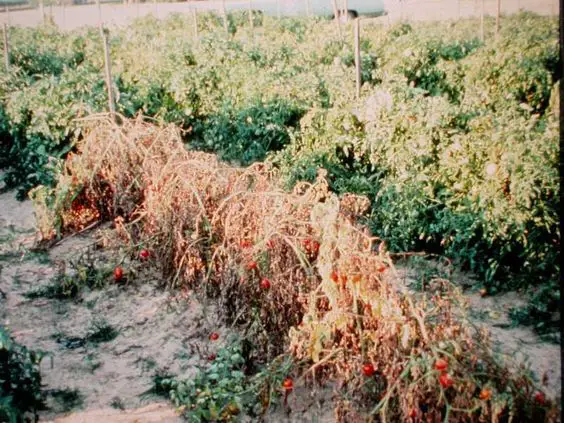
It is often confused with fusarium wilt, bacterial canker, or early blight. Symptoms are similar in all these diseases.
The fungus works its way up through the plant’s roots, clogging water-conducting tissue in the stem. It spreads a toxin that wilts and spots leaves and prevents water from reaching branches and leaves, starving the plant. Infected plants usually survive the season but are stunted. If they produce any fruit, it’s small and underdeveloped.
Before you leave ...
Get your free copy of "10 Must-Know Tomato Growing Tips." This 20-page guide is filled with tips you need to know to have a successful tomato crop, whether you’re a beginning or experienced gardener.
What does verticillium wilt look like?
Look for these symptoms:
Yellow spots appear on lower leaves, followed by brown veins. Leaves then turn brown and fall off.
Infection pattern often resembles a V-shape. Symptoms progress up the stem.
Plants may wilt during the day and recover at night.
Interior of main stem (when split) shows discolored streaks about 10-12 inches above the soil line, the result of plugged water-conducting tissue.
If cool conditions persist, the plant may die.
When does verticillium wilt affect plants?
- The fungus thrives in cool temperatures and when soil is moist and not too warm (60-75ºF).
- It can attack at any stage in a tomato plant’s growth, but is most common when plant is producing fruit.
- Plants in poorly drained soil are more susceptible to infection than those in well-drained soil. Wet soil allows the fungus to multiply and move up through the tomato plant’s water-conducting tissue.
How do verticillium wilt symptoms differ from symptoms of other diseases?
When compared with fusarium wilt. Verticillium develops more slowly than fusarium wilt. Yellowing is less dramatic with verticillium and encircles the entire plant, while those infected with fusarium tend to show symptoms just on one side.
Interior stem discoloration extends just 10-12 inches high in tomatoes infected with verticillium wilt, but all the way up the stem in those infected with fusarium wilt.
When compared with early blight. Spots from early blight develop concentric circles; verticillium spots do not.
When compared with bacterial canker. Verticillium symptoms encircle the entire plant. Those infected with bacterial canker tend to show symptoms on just one side.
How do you control and treat it?
- To date, there is no chemical treatment available.
- To slow the disease, use fertilizers lower in nitrogen and higher in potassium.
- Destroy infected plants.
How do you prevent the fungus?
- Rotate crops. The verticillium fungus can survive indefinitely in the soil. Plant tomatoes no more than once every four years in the same spot. Avoid planting other Solanaceous crops (potato, pepper, and eggplant) in the same area, too – they are susceptible to the fungus.
- Choose disease-resistant tomato varieties. A “V” listed after the variety name on its label indicates its resistance to the verticillium fungus.
- Plant tomatoes in well-drained soil.
- Remove and destroy affected plants at the end of the season.
Extra facts to know
Verticillium wilt also attacks eggplant, okra, pepper, potato, strawberries, and 200+ other plants.
Other tomato problems
Your Wilting Tomato Plant: Can You Revive It?
How to identify and treat fusarium wilt ...
How to identify and treat bacterial wilt ...
How to identify and treat tomato spotted wilt virus ...
How to identify and treat walnut wilt ...
Identifying tomato plant diseases: compare 5 kinds of tomato wilt ...
Different kinds of tomato blight and how to tell them apart ...
How to identify and treat early blight ...
How to identify and treat late blight ...
How to identify and treat Septoria leaf spot ...
How to identify and treat gray leaf spot ...
How to understand tomato disease resistance codes ...
How to identify tomato problems and prevent them ...
More on tomato diseases on our Pinterest board ...
Return from Tomato Problems: Verticillium Wilt to Tomato Dirt home
As an Amazon Associate and Rakuten Advertising affiliate I earn from qualifying purchases.
SHARE THIS PAGE:
FREE! 10 Must-Know Tomato Growing Tips: 20-page guide
Get yours here:


New! Comments
Have your say about what you just read! Leave a comment in the box below.