
Seed Starting Mix for Tomatoes: What Ingredients are Important
Since 2010, Tomato Dirt has garnered 4.8+ million views, making it the web’s leading online source for growing tomatoes in the home garden. Award-winning writer and Tomato Dirt owner Kathy Widenhouse has helped thousands of home gardeners grow healthier tomatoes. Be one of them when you get Tomato Dirt’s Growing Guide here.
Updated 3.20.25
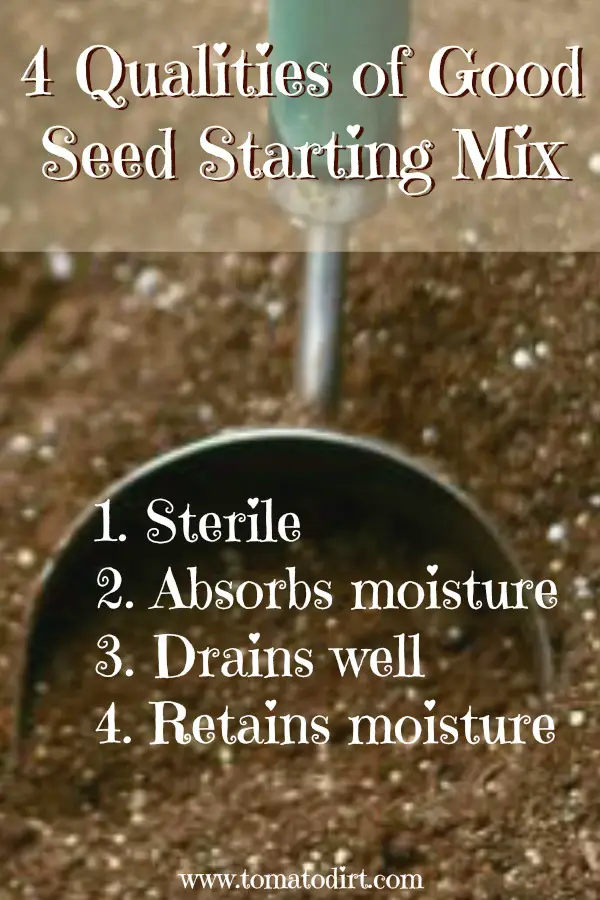
The best seed starting mix for tomatoes has four qualities:
- It is sterile
- It absorbs moisture
- It drains well
- It retains moisture

The most common base ingredients in commercial mixes are sphagnum peat moss, perlite, vermiculite, and lime. Another potting mix ingredient that is growing in popularity is coco coir (also called coconut coir, potting coir, or simply coir.)
A seed starting mix with these ingredients is often labeled as “soil-less.” In the truest sense, these ingredients contain no soil or dirt and are considered to be sterile. They are not jam-packed with living organisms.
Garden soil, on the other hand, is filled with organic matter and is home to active bacteria and fungi. That means if you grow tomato seeds in garden soil, they’re much more susceptible to the dreaded damping-off disease that kills so many seedlings.
Sphagnum peat moss, vermiculite, perlite, and coir complement each other well in a seed starting mix. Sphagnum peat absorbs water. Perlite allows adequate drainage, which lets roots have plenty of oxygen. Vermiculite retains moisture so that plants don’t dry out but have access to nutrients. Coir retains moisture, offers good drainage, doesn't compact, and is a renewable resource.
Well-balanced, prepared mixes combine these ingredients.
Before you leave ...
Get your free copy of "10 Must-Know Tomato Growing Tips." This 20-page guide is filled with tips you need to know to have a successful tomato crop, whether you’re a beginning or experienced gardener.
Sphagnum peat moss
Most sterile commercial seed starting mixes are peat-based with added ingredients for aeration.
Peat is partially decomposed organic matter. It has been compressed in low-lying ground where water sits, containing hardly any oxygen. That slows decay, leading to partially-carbonized composites.
The resulting material, peat moss, is organic and acidic. Its acidity inhibits bacteria and fungi – a plus for new plants. When dry it forms a water-repellent crust.
Specifically, sphagnum peat moss is derived from sphagnum moss and considered to be a high quality peat. It is the most preferred type of peat for horticultural purposes. Sphagnum peat can hold up to 20 times its dry weight in water. Its ability to absorb water helps keep new seedlings moist. But sphagnum peat moss works best for seed starting when combined with other ingredients to retain water (not just absorb it), loosen the mixture, and give roots some breathing room.
Perlite
Perlite, a form of volcanic glass, is a mined material. Its strength is aeration. Perlite allows a seed starting mix or potting mix to have tiny air pockets and keep the mixture drained. This prevents overwatering that can easily lead to drowning for new seedlings and plants grown in containers. Perlite is also very inexpensive. Its biggest drawback is also its strength: it doesn't retain water well, which means it dries out quickly. That’s why it’s most useful when combined with ingredients that hold moisture, like sphagnum peat moss and vermiculite. Use a dust mask when handling dry perlite since it can easily be inhaled.
Vermiculite
Vermiculite is a naturally-occurring, shiny, flaked mineral that resembles mica. It retains moisture well (about 200% - 300% by weight). It’s also inexpensive. Vermiculite’s water-retentive properties allow it to easily distribute nutrients to plants. The major drawback of vermiculite is that it retains too much water if used solely on its own and can suffocate the roots of plants. It’s most effective if used in combination with other ingredients. Use a dust mask when handling dry vermiculite since it can easily be inhaled.
Coco coir
Coco coir is coconut husk residue. Gardeners are excited about coco coir (pronounced “kwaher”) because it drains well and needs less watering than most potting mixes. Another significant advantage to coir is that it is a renewable resource. Coco is a by-product of the coconut-processing industry. As coconuts are grown and harvested, more coco coir is produced. Read more about coco coir and its benefits as a potting mix medium.
What about fertilizer?
Most seed starting mixes contain trace nutrients at most. There’s little need for added nutrients at this early stage because a plant’s initial nourishment is already packed inside the seed itself. But once seedlings have two sets of true leaves, it’s time to feed them a bit. You can add a bit of compost when you transplant tomato seedlings to their next size container or include a small amount of water-soluble fertilizer (such as Miracle Gro for tomatoes) in your moistening regimen.
Be sure to check for lime
If you select a peat-based seed starting mix, check the label. Make sure it contains a little lime to reduce the acidity and create a balanced combination – or add a dash on your own – because sphagnum peat moss is acidic.
More on potting mixes to grow tomatoes
Potting Mix vs Potting Soil: Which Should You Use?
Seed starting potting mix to use when growing tomato seeds ...
How to make your own potting mix for growing tomatoes ...
Sterile potting mix: do you need it for growing tomatoes?
Review: Pro-Mix seed starting formula for growing tomato seeds ...
Review: Coco coir as a potting medium for tomatoes ...
More on growing tomatoes from seeds
Compare seed starting kits for growing tomatoes ...
Compare biodegradable tomato seed starting pots to use to grow tomato seeds...
Grow tomatoes from seeds: what you need to know ...
When to start tomato seeds in your area ...
Tomato seed starting timetable ...
How to plant tomato seeds ...
Tomato growing tips for seeds ...
Learn what tomato seedlings need after they germinate ...
Damping off disease in tomatoes ...
More tomato seedling tips on our Pinterest board ...
More about starting and growing tomatoes on our Pinterest board ...
Return from Seed Starting Mix for Tomatoes to Tomato Dirt home
As an Amazon Associate and Rakuten Advertising affiliate I earn from qualifying purchases.
SHARE THIS PAGE:
FREE! 10 Must-Know Tomato Growing Tips: 20-page guide
Get yours here:
New! Comments
Have your say about what you just read! Leave a comment in the box below.