

Tomato Diseases: How to Identify and Treat Fusarium Wilt
Since 2010, Tomato Dirt has garnered 4.8+ million views, making it the web’s leading online source for growing tomatoes in the home garden. Award-winning writer and Tomato Dirt owner Kathy Widenhouse has helped thousands of home gardeners grow healthier tomatoes. Be one of them when you get Tomato Dirt’s Growing Guide here.
Updated 6.16.24
Fusarium wilt (fyoo-zair-ee-uhm) is a disease caused by a fungus, Fusarium oxysporum f. sp. Lycopersici, which lives in the soil. It is often confused with verticillium wilt because both produce similar symptoms in tomatoes.
The fungus works its way up through the plant’s roots, clogging water-conducting tissue in the stem. That prevents water from reaching branches and leaves, starving the plant. Affected plants produce very few tomatoes. Often, the entire plant dies.
Before you leave ...

Get your free copy of "10 Must-Know Tomato Growing Tips." This 20-page guide is filled with tips you need to know to have a successful tomato crop, whether you’re a beginning or experienced gardener.
What does fusarium wilt look like?
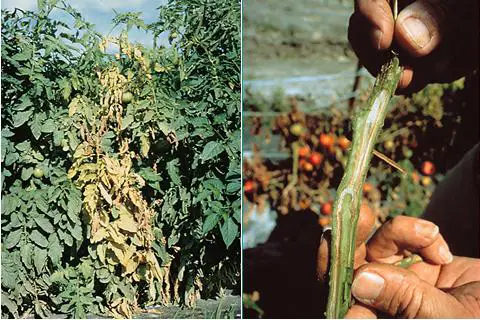

First signs are yellowing and wilting on one side of the plant – a leaf, single shoot, branch, or several branches.
Yellowing and wilting move up the plant as the fungus spreads.
Wilted leaves dry and drop prematurely.
Interior of main stem (when split) shows discolored streaks from plugged water-conducting tissue.
If the plant doesn’t die, it will be weak and produce inferior tomatoes
When does fusarium wilt affect plants?
- The disease can attack at any stage in a tomato plant’s growth, but symptoms are most common right after tomato blossoms appear.
- The fungus favors temperatures between 70º-90ºF and wet weather, which allows it to spread more easily.
- Plants in poorly drained soil are more susceptible to infection than those in well-drained soil. Wet soil allows the fungus to multiply and move up through the tomato plant’s water-conducting tissue.
How do you control and treat it?
- To date, there is no chemical treatment available.
- Destroy infected plants immediately.
- To slow the disease, keep soil pH between 6.5 and 7.0 and use a nitrate-based nitrogen fertilizer rather than an ammonia-based nitrogen fertilizer.
How do you prevent the fungus from infecting plants?
- Rotate crops. The fusarium fungus can survive indefinitely in the soil. Plant tomatoes no more than once every four years in the same spot. Avoid planting other Solanaceous crops (potato, pepper, and eggplant) in the same area, too – they are susceptible to the fungus.
- Choose disease-resistant tomato varieties. An “F” listed after the variety name on its label indicates its resistance to one or more strains of the fungus.
- Plant tomatoes in well-drained soil.
- Remove and destroy affected plants at the end of the season.
Extra facts to know
Fusarium wilt is more serious when root-knot nematodes are present. They weaken the plant and allow the fungus to spread more readily.
Other tomato diseases
How to understand tomato disease resistance codes ...
Your Wilting Tomato Plant: Can You Revive It?
Fungicide for Tomatoes: A Primer ...
How to identify and treat verticillium wilt ...
How to identify and treat bacterial wilt ...
How to identify and treat tomato spotted wilt virus ...
How to identify and treat walnut wilt ...
Identifying tomato plant diseases: compare 5 kinds of tomato wilt ...
Different kinds of tomato blight and how to tell them apart ...
How to identify and treat early blight ...
How to identify and treat late blight ...
How to identify and treat Septoria leaf spot ...
How to identify and treat gray leaf spot ...
How to identify tomato problems and prevent them ...
More about tomato diseases on our Pinterest board ...
Return from Tomato Problems: Fusarium Wilt to Tomato Dirt home
As an Amazon Associate and Rakuten Advertising affiliate I earn from qualifying purchases.
SHARE THIS PAGE:
