
Tomato Diseases: How to Identify and Treat Bacterial Wilt
Since 2010, Tomato Dirt has garnered 4.8+ million views, making it the web’s leading online source for growing tomatoes in the home garden. Award-winning writer and Tomato Dirt owner Kathy Widenhouse has helped thousands of home gardeners grow healthier tomatoes. Be one of them when you get Tomato Dirt’s Growing Guide here.
Updated 6.16.24
Bacterial wilt (also called "southern bacterial wilt") is a disease caused by a bacterium, Pseuclomonas solanacearum, which lives in the soil. Its symptoms are different from other tomato wilt diseases. When bacterial wilt attacks, foliage doesn’t become yellow and spotted. Rather, the plant wilts and dies quickly with little warning.
Bacteria work their way up through the plant’s roots or stem, most often where plants have been cut, injured or weakened by transplanting, cultivation, insects, or other diseases. They clog water-conducting tissue in the stem. Water and nutrients can’t reach branches and leaves, starving the plant. The plant dies.
Before you leave ...
Get your free copy of "10 Must-Know Tomato Growing Tips." This 20-page guide is filled with tips you need to know to have a successful tomato crop, whether you’re a beginning or experienced gardener.
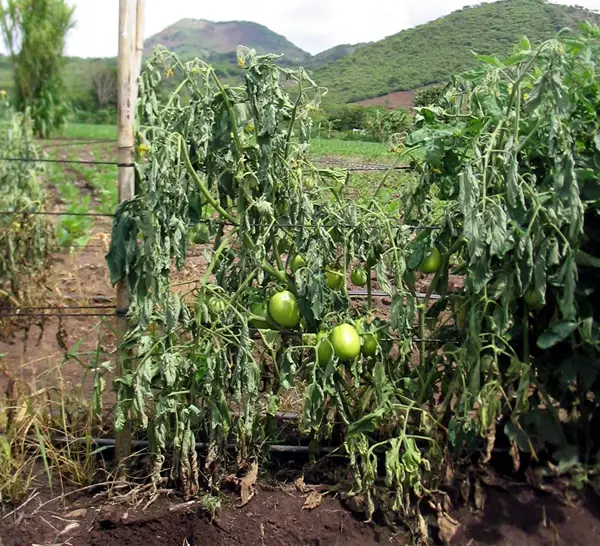

What does bacterial wilt look like?
- Foliage wilts suddenly
- Foliage remains green
- Interior of main stem (when split) is dark and water-soaked, the result of plugged water-conducting tissue. In late stages, the stem may become hollow.
When does it affect plants?
Bacteria are most active in temperatures above 75ºF, in wet conditions, and when soil has a high pH.
How can you know that it’s bacterial wilt for certain?
- Cut a portion of an infected stem (for best results, choose one at or near ground level)
- Check to see if stem interior is discolored
- Place cut stem in a glass of clear water
- Look for the telltale white, milky ooze running out of cut stem end
How do you control and treat bacterial wilt?
- To date, there is no chemical treatment available.
- Avoid physical damage to roots and stems, especially when planting and cultivating.
- Control root-knot nematodes, which are known to weaken tomato roots and allow bacteria access to plants.
How do you prevent bacterial wilt?
- Rotate crops. Bacterial wilt can survive indefinitely in the soil. Plant tomatoes no more than once every four years in the same spot. Avoid planting other Solanaceous crops (potato, pepper, and eggplant) in the same area, too – they are susceptible to the bacterium. Instead, plant non-susceptible crops in those spots, like beans, corn, and cabbage.
- Choose resistant varieties. Neptune, Tropic Bay, and Kewalo are varieties that are considered to be partially resistant to bacterial wilt, although they are not commonly grown.
- Plant tomatoes in well-drained soil with a balanced pH.
- Space plants generously. Extra room in between plants allows air to circulate.
- Remove and destroy affected plants at the end of the season. Till surrounding soil to reduce spread of the disease.
- Wash your hands after handling infected plants.
Extra facts to know
- Bacterial wilt also attacks eggplant, pepper, potato, cosmos, and sunflower.
- Bacterial wilt is common in Florida and other high temperature, high humidity regions.
Other tomato problems
Your Wilting Tomato Plant: Can You Revive It?
How to understand tomato disease resistance codes ...
How to identify and treat fusarium wilt ...
How to identify and treat verticillium wilt ...
How to identify and treat tomato spotted wilt virus ...
How to identify and treat walnut wilt ...
Identifying tomato plant diseases: compare 5 kinds of tomato wilt ...
Different kinds of tomato blight and how to tell them apart ...
How to identify and treat early blight ...
How to identify and treat late blight ...
How to identify and treat Septoria leaf spot ...
Fungicide for Tomatoes: A Primer...
How to identify and treat gray leaf spot ...
How to identify tomato problems and prevent them ...
Return from Tomato Diseases: Bacterial Wilt to Tomato Dirt home
As an Amazon Associate and Rakuten Advertising affiliate I earn from qualifying purchases.
SHARE THIS PAGE:
