
FREE: 10 Must-Know Tomato Growing Tips Get The Guide
Read our affiliate disclosure here.
Staking Tomatoes vs Cages vs Trellises: Which Is the
Best?
Since 2010, Tomato Dirt has garnered 4.8+ million views, making it the web’s leading online source for growing tomatoes in the home garden. Award-winning writer and Tomato Dirt owner Kathy Widenhouse has helped thousands of home gardeners grow healthier tomatoes. Be one of them when you get Tomato Dirt’s Growing Guide here.
Posted 5.10.26
Staking tomatoes vs cages vs trellises: If you grow tomatoes long enough, you eventually run into the same question every gardener faces: how should I support these plants?
Tomatoes don’t naturally stay tidy or upright. Left alone, they sprawl across the ground, tangle into a messy jungle, and produce fewer healthy fruits.
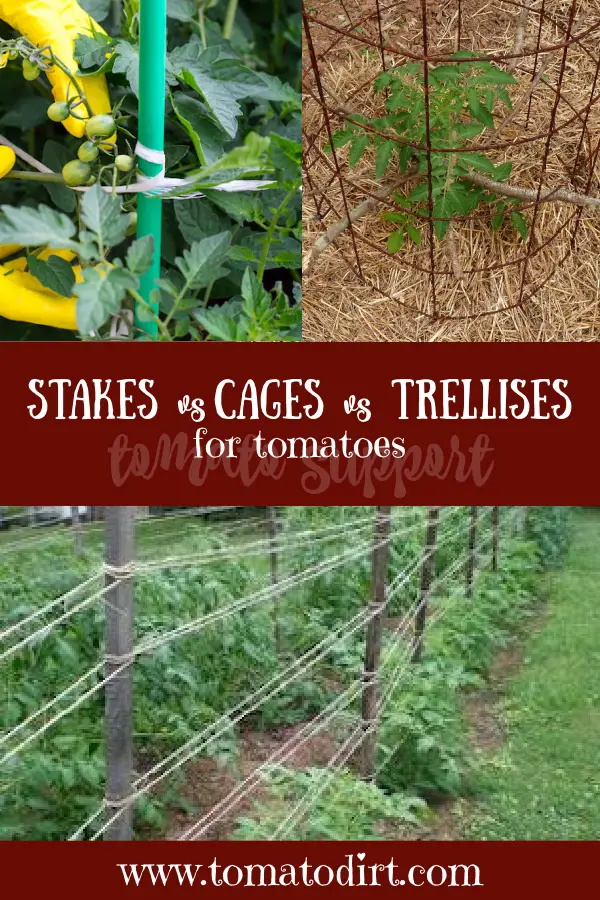
The three most common support methods—staking, tomato cages, and tomato trellises—solve the problem in different ways. One size does not fit all. The best choice depends on your space, tomato variety, climate, and how much maintenance you want to do during the season.
We’ll compare the three types of tomato support to help you choose the right system (or combination) for your garden. But first …
Before you leave ...
Get your free copy of "10 Must-Know Tomato Growing Tips." This 20-page guide is filled with tips you need to know to have a successful tomato crop, whether you’re a beginning or experienced gardener.
Why tomato support matters
Supporting tomatoes is not just about keeping plants upright. It also:
- Keeps fruit off the soil, reducing rot, pests, and garden clean-up.
- Improves air circulation, which reduces disease because spores and fungi can’t move so freely from plant to plant.
- Makes harvesting easier because you can reach the fruit.
- Helps plants focus energy on fruit production instead of sprawling growth.
- Maximizes space in small gardens.
Let’s look at how each system handles those goals.
Staking Tomatoes vs. Cages vs. Trellises
1. Tomato stakes
When it comes to support, staking tomatoes is the simplest and most traditional method. You drive a strong stake into the ground. As the plant grows, you tie branches to the stake so the plant remains upright.
How it works
A wooden, bamboo, or metal stake (usually 4–8 feet tall) is placed near the plant. As the tomato grows, you tie the main stem to the stake every 8–12 inches.
Advantages of staking tomatoes
- Efficiency. Staked tomatoes grow vertically with minimal footprint, making this ideal for small gardens or raised beds.
- Better airflow. Because your plant is upright, growth is more controlled and open. Plants dry quickly after rain, which reduces fungal diseases.
- Large, high-quality fruit. Pruning and vertical growth lead to fewer – but larger – tomatoes.
- Easy harvesting: You can easily see and reach the tomatoes to pick them.
Disadvantages of staking tomatoes
- Plants must be pruned. To keep a single main stem, you must regularly remove suckers (side shoots). This means you’ll invest extra time maintaining your plants throughout the season.
- Plants must be tied. And it takes time. You must check plants every couple of weeks for new branches and then tie them to the stake. Tying takes effort and consistency.
- Plants are less forgiving. If you miss pruning or tying, plants quickly become tangled and unstable. In particular, large, sprawling indeterminates can outgrow stakes or snap ties under fruit weight.
Best use cases for tomato staking
- Small gardens or tight spaces
- Raised beds
- Gardeners who prefer disciplined, hands-on plant training
- Large-fruit varieties (like beefsteak tomatoes)
- Hot, humid climates where airflow is critical
2. Tomato cages
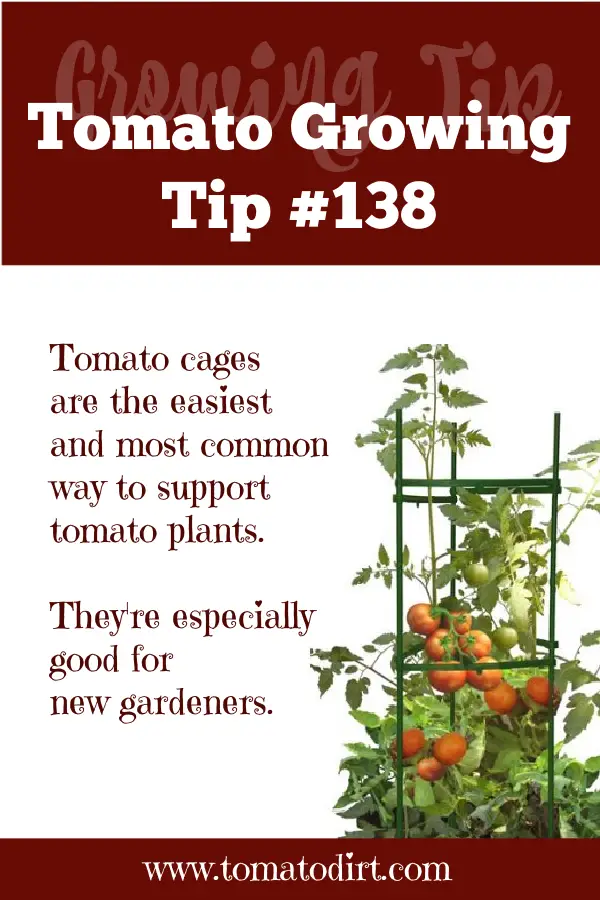
A tomato cage is a wire or metal structure that surrounds the plant and supports it as it grows. Cages are the most common home-gardening support method for tomatoes.
How it works
The plant is placed inside a cage (usually cylindrical or square), and it grows upward and outward, leaning on the structure for support.
Advantages of tomato cages
- Maintenance is easy. Once you install, cages require minimal intervention. No tying needed, no frequent pruning is necessary – although at Tomato Dirt, we occasionally tie heavy tomato branches onto cage sides to give the plants added support.
- Plants grow naturally. Their branches aren’t twisted along a stake, so they grow towards the sun. Tomatoes stay off the ground, reducing rot and pest damage.
- Cages are beginner-friendly. It’s the simplest support system to start with.
Disadvantages of tomato cages
- Cages are bulky. Cages take up more horizontal space in the garden than staking or trellising. Plus, you have to store them during the off-season.
- Cages are expensive (initially). Cheap or small cages offer limited support for large tomato varieties. That’s why more experienced gardeners build their own cages from concrete wire remesh or purchase large, sturdy cages that last.
- Cages hide fruit. Tomato foliage fills in cages. Fruit hidden in thick growth can be difficult to find or reach at harvest time.
- Cages can limit airflow. Dense interior growth can trap moisture, increasing disease risk in humid climates.
Best use cases for tomato cages
- Beginner gardeners
- Small to medium gardens with space for wide plants
- Determinate or semi-determinate tomato varieties
- Gardeners who prefer low-maintenance systems
- Mild climates with moderate disease pressure
3. Tomato trellises
Trellising is a more advanced but highly efficient tomato staking system. Plants are trained along horizontal or vertical support structures, often using strings, panels, or overhead wires.
How it works
Plants are tied to vertical strings or guided along a structure such as a cattle panel, fence, or A-frame trellis, directing their growth continuously upward.
Advantages of tomato trellises
- Maximum productivity in small spaces. Trellising allows you to grow many plants in a narrow row or vertical plane.
- Excellent airflow and disease control. Plants are spaced and trained for openness, which reduces their exposure to fungal diseases.
- Easy harvesting. Fruit is exposed. It’s easy to access and pick.
- Scalability. If you have a market garden or are looking for an exceptionally high-yield system, trellising is the way to go.
Disadvantages of tomato trellises
- Trellises require significant setup. You need to construct your tomato trellis or at the very least, install strong supports that can hold the crosswise strings or wires.
- Trellises require ongoing maintenance. Plants must be regularly trained upward, especially indeterminate varieties. You’ll need to tie plants throughout the season. Without guidance, plants can become uneven or fall over.
- Trellises require more take-down and storage. Once plants are spent, you’ll need to remove debris, take apart the trellis, and store it.
Best use cases for tomato trellises
- Serious gardeners or small-scale market growers
- High-density planting systems
- Indeterminate varieties
- Humid climates where disease prevention is important
- Gardeners who are comfortable with regular plant training
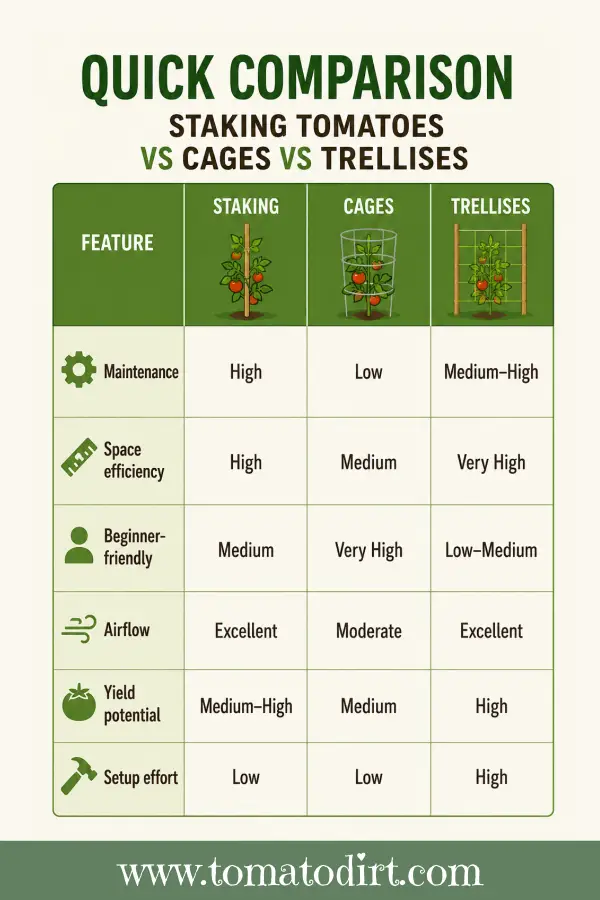


Staking tomatoes vs cages vs trellises: which system is
best?
There is no single “best” method—only the best fit for your situation.
Choose tomato stakes if you want:
- High control over plant shape
- Clean, organized garden rows
- Large tomatoes and strong airflow
- Willingness to prune and manage plants regularly
Choose tomato cages if you want:
- Simplicity and low maintenance
- A forgiving system for beginners
- Natural plant growth with minimal intervention
- Moderate yields without much effort
Choose tomato trellises if you want:
- Maximum production in a small space
- Efficient vertical gardening
- Strong disease prevention in humid climates
- A system you can scale up over time
A practical tip for choosing between tomato stakes vs
cages vs trellises
You don’t need to rely on just one system. You can mix your tomato support methods:
- Cages for patio or casual plants
- Stakes for large-fruited or experimental varieties
- Trellises for main production rows
This hybrid approach lets you match support style to plant behavior—not force every tomato into the same system.
A final thought about staking vs cages vs trellises
Tomatoes don’t fail because gardeners choose the “wrong” support system. They fail when the system doesn’t match the gardener’s time, space, and goals.
- If you want simplicity, cages win.
- If you want precision and airflow, staking works well.
- If you want efficiency and production, trellises are hard to beat.
The best system is the one you’ll actually maintain consistently through the season.
More tips for staking tomatoes
How to stake and tie tomatoes for support ...
How to tie up tomato plants ...
3 Do-It-Yourself Tomato Trellis Ideas ...
How to build a tomato trellis for staking tomatoes ...
Make your own tomato cages ...
More tips for staking tomatoes on our Pinterest board ...
Return from Staking Tomatoes vs Cages vs Trellises to Tomato Dirt home
As an Amazon Associate and Rakuten Advertising affiliate I earn from qualifying purchases.
SHARE THIS PAGE:
