

Review: Tomato Cages from Gardener’s Supply
Since 2010, Tomato Dirt has garnered 4.8+ million views, making it the web’s leading online source for growing tomatoes in the home garden. Award-winning writer and Tomato Dirt owner Kathy Widenhouse has helped thousands of home gardeners grow healthier tomatoes. Be one of them when you get Tomato Dirt’s Growing Guide here.
Updated 5.13.24
Why spend a little extra on tomato cages? There’s a simple reason: sturdy durability.
If you grow tomatoes every year, then you’ll want to consider investing in cages that last. One of the best kinds we've seen are Gardener's Supply cages.
Before you leave ...
Get your free copy of "10 Must-Know Tomato Growing Tips." This 20-page guide is filled with tips you need to know to have a successful tomato crop, whether you’re a beginning or experienced gardener.
“Are they really better than those cone tomato cages that I can get for a few bucks?”
Yep.
Cone cages (tomato baskets) sold at discount department stores and home improvement centers are less expensive than GS cages.
But they’re flimsy. Their tines bend easily. They work only for the smallest tomato plants and don’t withstand strong rains and thunderstorms. The interior support rings are quick to break out when fruit gets heavy.
Even if your tomatoes only grow to half their expected size (which likely won’t happen if you read Tomato Dirt!), your plants will quickly overpower the cone cages.
“But what about staking plants with poles instead of using cages?”
For decades, gardeners have been driving stakes into the ground and tying up branches all season long.
Poles, posts, sticks, and branches used to support tomatoes all present this time-consuming problem. GS cages are huge time savers. They’re also healthier for the plants because they’re more stable. Branches won’t snap off as easily. Since plants are upright in cages there is better air circulation.
Learn more about GS tomato cages. You can also check out different tomato cages to find the right ones for you and your garden.


What makes Gardener’s Supply Tomato Cages especially good?
Among other things, these babies provide heavy-duty support for tomato plants. That’s especially important if you grow indeterminate tomatoes, which keep getting bigger and bigger as the season progresses.
There are several other qualities for you to consider about GS cages.
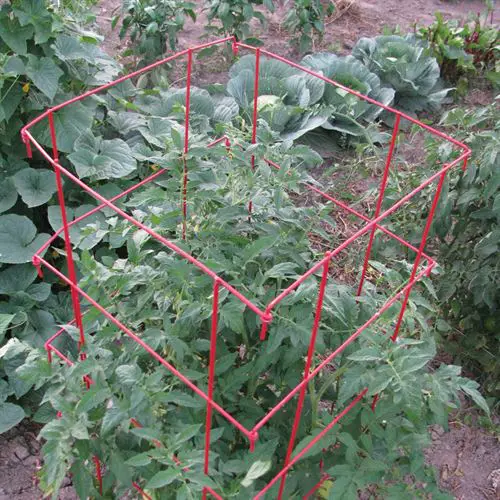
- Strength. They’re made of higher-gauged, higher-quality galvanized steel than other cages. GS cages are strong enough to support even the largest tomato plants, which can get very heavy when loaded with fruit. The tines are 7 inches long, which is more than enough to anchor cages deeply into the soil. Other cages (especially the cone variety) have just 2-3 inch tines. Not good when there’s wind. Can you say “tomato topple”?
- Shape. GS cages are different in that they are square, making them more stable in the ground. Straight sides are easier to handle when setting up. Straight sides are also more secure as the season progresses. (Round cages tend to fall over as plants mature.)
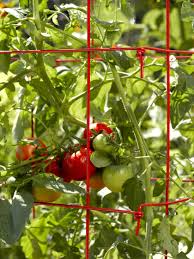
- Size. Healthy tomato plants get BIG. Each side of the GS tomato cage is 14 ½ inches. The space between cage wires is large enough (8 inches) to stick your hand in and pick tomatoes. That also means there’s plenty of room for tomato branches to reach out for support. Plants aren’t squished together.
- Reusability. GS tomato cages fold and lay flat for winter storage. They may cost more, but they last for years.
- Convenience. They’re easy to set up and you don’t have to keep tying branches. Occasionally you’ll need to prune a sucker or guide a wayward branch back into the cage. Big deal – you’ll save hours.
- Versatility. If your plants get large – that is, taller than 4 feet – you can add extensions to the GS cages for more height. (Check out the cage extensions here.) Because they’re vertical and well-supported, your tomato plants also get better circulation, which helps prevent diseases from spreading so easily. If you have a small garden or limited space these cages allow your plants to grow upright and save your real estate from tomato sprawl. You can also use these cages for plants other than tomatoes, like peppers, eggplants, cucumbers, peas, pole beans, roses, larger dahlias, or lilies.As an added bonus, GS cages deter deer!
Tips for setting up cages
- Unfold cages carefully so you don’t pinch your fingers.
- Be careful not to poke yourself on wires at the hinges.
- Place your hands on the welded corners as you insert tines into the ground. That will help stabilize the cage during set up.
- Keep track of the clips so you can use them each year. Use extra earth staples to ground cages even more, making them more resilient in areas with high wind.
Look out for this
- You’ll probably need to get the cage extensions. GS cages stand just 32” above the soil line. Most tomato varieties get to be much larger than that.
- Wire on the cages can rust.
More on staking tomatoes
5 ways to stake tomatoes ...
Best methods for staking tomatoes ...
How to build round tomato cages ...
Homemade tomato cages for short season tomatoes ...
How to tie up tomato plants ...
How to stake and tie tomatoes ...
The perfect tomato staking tape ...
How to build a tomato trellis ...
3 Do-It-Yourself Tomato Trellis Ideas ...
See more tomato staking ideas on our Pinterest board ...
Return from Tomato Cages review to Tomato Dirt home
As an Amazon Associate and Rakuten Advertising affiliate I earn from qualifying purchases.
SHARE THIS PAGE:
FREE! 10 Must-Know Tomato Growing Tips: 20-page guide
Get yours here:
New! Comments
Have your say about what you just read! Leave a comment in the box below.