
The Tomato Hornworm: How to Identify and Control It
Since 2010, Tomato Dirt has garnered 4.6+ million views, making it the web’s leading online source for growing tomatoes in the home garden. Award-winning writer and Tomato Dirt owner Kathy Widenhouse has helped thousands of home gardeners grow healthier tomatoes. Be one of them when you get Tomato Dirt’s Growing Guide here.
Tomato hornworm (Manduca quinquemaculata) is a tomato pest with a big appetite! If left unchecked, it can consume a single tomato plant in just a couple of days.
Before you leave ...

Get your free copy of "10 Must-Know Tomato Growing Tips." This 20-page guide is filled with tips you need to know to have a successful tomato crop, whether you’re a beginning or experienced gardener.
It’s regularly confused with the tobacco hornworm (Manduca sexta), which is strikingly similar.
Both feed on members of the Solanaceae (nightshade family) such as tobacco, eggplant, peppers, potatoes … and of course tomatoes.
In fact, the tomato hornworm and the tobacco hornworm are often referred to interchangeably since they look alike and inflict the same kind of damage to your tomatoes. They have even been found on the same plants! Both are identified by their characteristic horn on one end (although each’s horn is a different color).
Whichever hornworm you find in your garden does not really make a difference. The main idea is to eliminate the pest so it won’t gobble up your tomatoes and plants.
What do the tomato hornworm and the tobacco hornworm look like?
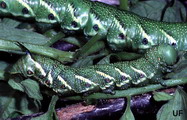 |
Tomato Hornworm |
- Shape: cylindrical; caterpillar-shaped
- Color: green, which allows them to blend in with the tomato plant
- Horn: tomato hornworm – dark blue, dark green or black; tobacco hornworm – red
- Markings:
tomato hornworm – eight, V-shaped white or yellowish strips across the torso
tobacco hornworms – seven, straight or diagonal white strips edged with black across the torso - Size: both can grow to be 3-4 inches long
What do the tomato hornworm and the tobacco hornworm do to plants?
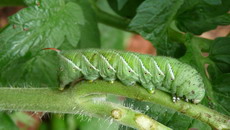 |
Tobacco Hornworm |
They attach themselves to the underside of a tomato’s leaves, making it difficult to find them right away. You may first recognize the hornworm’s damage at the top of a plant before you find the pest itself.
They feast on both tomato leaves and green tomatoes. Look for –
- stems missing leaves
- leaf wilt
- dark green or black pellet droppings (also called frass) on a lower leaf indicating the presence of a hornworm above
When do they do their work?
Both hornworms avoid the heat. They stay in the interior, shaded part of the plant during the day, and then move to the outside from dusk to dawn.
How can you control hornworms?
- Handpick hornworms – the most effective control method in the home garden. Cut them in half, squish them, or drop them into soapy water and dispose.
- Apply a natural insecticide BT (Bacillus thuringiensis, sold commercially as Dipel or Thuricide), especially when larvae are small. Thuricide is a natural formulation of a bacteria that is specific to leaf-eating insects. It's available as a concentrate in a couple of different sizes ( Bonide Bt Thuricide 8 Oz. and Bonide Bt Pint). Many gardeners spray it as a precaution, even before hornworms appear.
- Encourage natural enemies (rather than treat them). Braconid wasps (a parasitic wasp) sometimes lay white eggs on the hornworm and feed on it when they emerge. Leave them to help destroy tomato hornworms and other garden pests
- Chemical insecticides that have been proven effective on the hornworm include carbaryl, permethrin, and spinosad.
What’s the hornworm’s life cycle?
- Moths (also called “hawk,” “sphinx,” or “hummingbird” moths) over winter in the soil as dark brown pupae
- In the spring, moths emerge from soil
- moths lay round and greenish-white eggs on the undersides of leaves
- Eggs hatch in four to five days; hornworms emerge
- Larvae (what we know as hornworms) spend the next four weeks growing to full size
- Larvae move to the soil to build cocoons (pupae)
How can you prevent a hornworm infestation next season?
Till your garden after harvest. You’ll bury or destroy larvae, which are getting ready to build cocoons. Studies show that tilling can destroy up to 90% actively-cocooning larvae.
More on tomato pests
How to identify tomato pests and control them ...
How to Identify These 13 Common Bugs on Tomato Plants ...
Aphids on tomato plants: how to identify and control them ...
Tomato fruitworms: how to identify and control them ...
Stink bugs: how to identify and control them on tomato plants ...
Tomato worms-cutworms: keep them away with stem collars ...
How to identify and control indoor tomato pests ...
Tomato pests that attack tomatoes in pots ...
Tomato problems from diseases
Different kinds of tomato blight and how to tell them apart ...
How to identify and treat early blight ...
How to identify and treat late blight ...
How to identify and treat Septoria leaf spot ...
Tomato problems from growing conditions
Blossom end rot: how to identify, treat, and prevent it ...
Sunscald: why too much sun can be hazardous to tomatoes ...
Why a tomato cracks and what to do about it ...
Are bumps on tomato stems harmful to plants?
How to identify tomato problems and prevent them ...
Return from Tomato Hornworms to Tomato Dirt home
As an Amazon Associate and Rakuten Advertising affiliate I earn from qualifying purchases.
SHARE THIS PAGE:
FREE! 10 Must-Know Tomato Growing Tips: 20-page guide
Get yours here:


New! Comments
Have your say about what you just read! Leave a comment in the box below.